Showing posts with label Math. Show all posts

Thursday, October 9, 2014

Cheat Sheet For Visualizing The True Cost Of A Flight, And Whether To Purchase A Ticket Or Use Miles

Back in July, I put out my first attempt at developing a cheat sheet for visualizing the situations when it made sense to redeem miles for flights and which class to book. Since then, I've come across a couple situations that have me looking at this question in a slightly different way.

In my quest to re-qualify for Alaska Airlines MVP Gold status, which requires that I earn 50,000 elite qualifying miles (EQM's), I've been increasingly willing to pay for tickets when the price is right, rather than redeem miles. So the question becomes, when is the price right?

What's the net cost of an airline ticket?

At work we deal a lot with net costs, which in my case pertains to an employer's net health care spend after accounting for the amount that is collected from employees via payroll deductions. I'm sure you all know what I'm talking about - that $50, $100, or even $500 chunk that comes out of each paycheck to pay for health insurance. If you're providing an employer with their bottom-line costs, that money must be accounted for.

As another example, let's say there was a membership level at Costco that gave back $10 for every $100 you spent. If I walked in this afternoon, bought $100 worth of stuff, and received a $10 credit at month's end directly related to that purchase, then the net cost of today's purchase wasn't $100, it was $90.

But now, take the same scenario above, but instead of a $10 rebate you receive something without a well-defined dollar value, like raffle tickets, show tickets, or a meet and greet with a celebrity. Each and every person would place a different valuation on those items. For some those they may be worthless, others may place a value of $10, and to some they may be priceless.

And that's the situation we find ourselves in with airline tickets, and frankly where I'm a bit surprised that there isn't more focus on the net cost of our tickets purchases. We typically take the cost of the ticket, the flight distance, and use those numbers to calculate the cents-per-mile (CPM) cost of that ticket.

But every time you fly on a paid fare you are getting back a rebate, so to speak, in the form of elite qualifying miles and redeemable miles (RDM's) that absolutely have a non-trivial, material value. If they didn't, why would any of us be in this game?

What's the value of the miles earned?

Now comes the hard part, placing a value on the EQM's and RDM's that are earned as part of that flight. The trouble is that each person has their own valuation of those miles, and in many cases the same exact flight will even yield different earnings based on the fare class of the ticket as well as your level of status with the airline.

It's impossible to place an exact value on miles, so I took a different approach. Instead, I'm providing a broad scale that let's you figure out the correct answer for yourself, based on your own valuations.

In the graph below, I'm showing a recent example from my own personal experience. For my return flight from Dubai, I had my choice of booking a Business Class ticket home on Cathay Pacific with 67,500 American Airlines miles or $1,910. Crunching the numbers, it's roughly a 2.8 CPM redemption value. But that's without taking into account the EQM's and RDM's that would be earned.

The chart below shows what the net cost of that ticket would be, using a range of different valuations for both EQM and RDM's. The calculations take into account both the Class of Service and Elite bonuses, as well as the number of miles that would be required for an equivalent award redemption and the desired or target CPM for an award booking.


To me, the true comparison of when to book an award ticket vs. purchasing a flight must take the net cost into account. For example, if I valued EQM's and RDM's at 1.5 CPM each, then the net cost of my ticket drops from $1,910 to $1,335. And if my valuations of EQM's and RDM's are 3.0 CPM and 2.0 CPM, respectively, the net cost of my ticket drops even further to $1,007.

When to pay cash vs. redeem miles 

I've also layered in the colors, which signal when you should pay cash vs. redeem miles for a flight, based on the number of miles required and your desired CPM redemption value. In the example above, a redemption of 67,500 miles with a desired CPM redemption value of 3.0 CPM means that I should purchase all tickets with a net cost below $2,025. Since this was such a good deal, even if I placed no value on the miles earned I'd still be better off paying cash for the ticket than redeeming miles.

Let's look at a more typical example. For a round-trip Business Class ticket from LAX to DXB, that ticket can often cost upwards of $5,500. Using those figures, the chart now shows based on your personal valuation of the miles, when you should pay cash vs. redeem miles.


Now keep in mind, in no way am I suggesting that you should be shelling out $5,500 for a Business Class ticket in all of the cases above shown in red. Instead, this will show you purely based on the math of what you want to get out of your miles, when the trade-off between spending vs. earning miles makes sense.
 
And here's a typical example from my recent Alaska Airlines redemption for 100,000 miles to fly First Class from San Francisco to Seychelles, via Dubai. The round-trip cost of that same ticket comes in at a whopping $28,000, of which I'll use half as the one-way cost even though it doesn't always work out like that. As you can imagine, green all the way around in this scenario.


Negative net costs - making money by flying!

As an interesting note, let's also look at a typical mileage run situation. For example, let's say that you were able to snag a domestic fare for $300 that took you all across the US. With a convoluted routing that picked up some 500-mile minimums from short segments, a really good routing may yield up to 7,500 miles.

In this scenario, once you get above the 1.5 CPM valuations for EQM's and RDM's, you're actually in a situation where the net cost of your ticket is negative. In other words, you're making money by flying!


Well not literally, as the miles you're earning have no cash value. But this actually makes perfect sense - the whole reason we scour the forums for the cheapest, craziest, most convoluted mileage runs is that the value you're receiving by suffering through those flights, which ultimately comes in the form of elite status and miles to use for future bookings, outweighs the cash outlay.

As I mentioned at the beginning, we will never get to the point where everyone places the same, singular valuation on airline miles. The key is having the sensitivity analysis built-in, so that each person can see where they fit in along the valuation spectrum, and use that information to inform the best decision for themselves.

So happy mileage running to all, and I'd love to hear your feedback. I'm also happy to share the Excel tool with anyone that is interested.

Tuesday, July 22, 2014

When To Use Airline Miles For Flights And Which Class To Book: A Visual Cheat Sheet


There are few things in life with a larger divergence between price tag and perceived value than airline miles. If I'm willing to pay $5 at lunch for a sandwich, it's because I've decided that the value of that sandwich is worth the cost. Similarly, if I'm willing to pay $30,000 for a brand new car, I made that purchase because my valuation of the car is commensurate with that price tag.

It's been well documented and discussed by many (Lucky does a great job in a series of posts on this topic, the most recent of which is here) about the value of airline miles. In extreme cases, First Class airfare tickets can sell for as much as $20,000, and if that same seat is bookable using 160,000 miles, that puts the value of those miles at 12.5 cents-per-miles (CPM). But while I was willing to pay the sticker price for the sandwich and car in my previous example, would I really be willing to pay $20,000 for that First Class seat? Heck no. In fact, my personal valuation of First Class tickets is closer to 3X the cost of an Economy ticket on that same flight. That would bring the value of the First Class ticket in that example down to something like $5,000, and the CPM of that particular redemption down to 3.1 CPM.

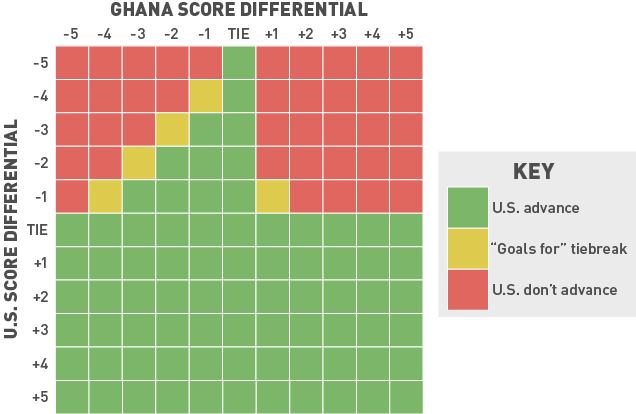
I was inspired by a post I read over at Deadspin during the World Cup where they outlined how all of the potential scenarios of the US vs. Portugal and Germany vs. Ghana games would impact the US's advancement into the next round of the tournament. I really liked the way the chart was presented, which grouped each of the 121 discrete outcomes into just three color-coded scenarios.


For some reason, that chart popped into my head when I was recently searching for award availability, and mulling over the value I would be getting on each possible redemption. Similar to the chart above, my thought-process was a series of decisions based on discrete scenarios, but instead of looking at goal differential I was comparing CPM of various Economy, Business, and First Class redemptions relative to my desired or target thresholds.

I imagine that's a similar question many of you ask yourselves each time you want to use airline miles  - "Is the CPM for this particular booking a good use of my miles?" The key here is that we can all agree that "good" is subjective, with some people valuing tickets using the actual sticker price, and others like myself, using something much lower.

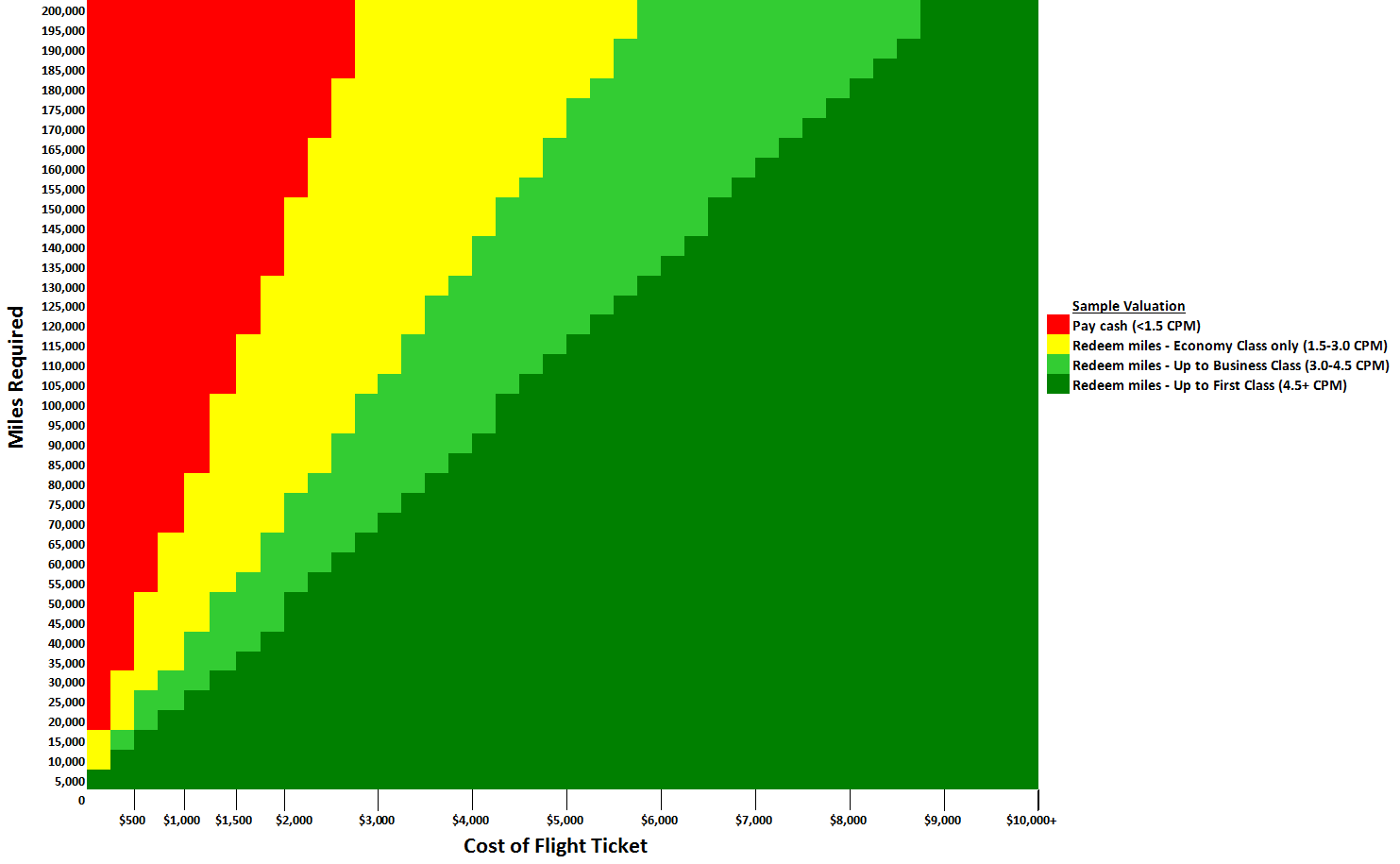
Based on an illustrative person's valuation of miles, the chart below shows a sample cheat sheet of when that person should use miles vs. cash for flights. It also shows the situations when using miles, when that person should book Economy, Business, or First Class tickets. Each cell in the chart represents a discrete situation based on number of miles required for a flight (Y-axis) and the cost of the flight ticket (X-axis). Baked into the CPM thresholds outlined in the key on the right, is the value that this person has placed on their miles at each booking class, which again will differ from person-to-person, and even by airline program.

For example let's say that this person is presented with the opportunity to redeem 140,000 miles on a flight redemption. At what point should they use miles, and if using miles, which class of ticket should they book? Based on this person's CPM targets, they would pay cash (shown in red) for any ticket up to a value of 1.5 CPM (~$2,100). Anything above that, then they would be willing to use miles. A similar decision-making process when choosing the class of booking. Based on this person's valuation of Business and First Class tickets relative to Economy class, they would be willing to book Business Class (in light green) within a range of 3.0-4.5 CPM in value ($4,200-$6,300), and First Class at a CPM greater value than 4.5 CPM ($6,300+).

It's important to note that the chart isn't saying anything about the typical number of miles needed to make a booking at each class (I know that it would be rare to need 140,000 miles to book an Economy ticket). Instead, it's simply showing the break-points at which this person would find enough CPM value to make a particular booking. For example, if someone was offered Business Class tickets for 140,000 miles and valued at $4,000, they they would happily make that booking since the value exceeds their target thresholds. However, the value would be too low to be considered an acceptable First Class booking.

As I mentioned, the key assumption here is baked into the CPM thresholds, which is each individual's valuation of their miles. Personally, I value Business Class tickets at only 2X the value of Economy tickets, even though they can easily cost 3-4x as much. Similarly, I value First Class tickets around 3X the cost of Economy, while actual costs can easily be 6-10X as much. Therefore, I have a lower value on premium cabin tickets than the sample person above, and therefore would require higher CPM redemption values before willing to make the same booking, as illustrated in the chart below:

As you can see here, while the sample person would be willing to book First Class tickets for 140,000 valued at $6,300, I wouldn't be willing to make that booking unless the flight ticket cost exceeded $9,800.

A couple of notes on methodology - I chunked the mileage redemptions into 5,000 mile increments, and the cost of flight tickets into $250 increments. While there is a clear line drawn between the colors, in reality there is a grey area between neighboring cells that cross into different colors. This would be especially prevalent in low mileage / low cost redemptions that you would find with domestic tickets.

So did I solve the million-dollar question "what is the value of airline miles?" Nope. But the value of this exercise for me was to, through some trial and error, determine what my "acceptable" thresholds really are that I am looking to get out each type of booking. Until now, it's a calculation that I had been doing anyways each time I looked at a potential redemption, but this was a good way to visualize the entire spectrum and to really see where those break points are.

I'm curious, what is your process for determining when an airline mileage redemption is a "good" value?