Showing posts with label Mileage Redemptions. Show all posts

Monday, September 8, 2014

My Experience Using Alaska Miles To Book Emirates First Class


Sorry for the sporadic blog posts as of late - work has been absolutely crazy and has taken over my evening time, which I've historically tried to reserve for blogging (and the occasional trashy reality TV show). But I'm currently in the middle of a 2-week vacation to Dubai and Seychelles (full trip report to come!) and am looking forward to using this break from work to catch up on my blogging. As an added bonus, the trip will even include a stopover in Vegas for BACON, the annual BoardingArea conference, and I'm sure you'll be hearing a lot about that from all the bloggers in the coming weeks.

Back to the original reason for this post - after spending the first part of the year quickly accruing Alaska Airlines miles, I reached the 200,000 mile mark which is enough to book 2 one-way tickets anywhere in the world in First Class. Every since my 1st experience with Emirates last year I had been dreaming of an encore, and this would be the perfect opportunity as Emirates would provide the most efficient routing to fly from SFO to the Seychelles.

As I wrote about a couple weeks ago, I'd been closely studying premium cabin award availability (either First Class or Business Class) on Emirates via Alaska Airlines miles, and provided some initial insight. For those that are looking for premium cabin seats from North America to Dubai, I provided my initial not-very-scientific ranking of the best routes for availability:

Everyday and twice on Sundays
1. Chicago (Boeing 777-200LR)
2. Houston (Boeing 777-300ER)
3. Washington DC-IAD (Boeing 777-300ER)
4. Dallas (Boeing 777-200LR)

Look hard, but it's there
5. Boston (Boeing 777-300ER)
6. Seattle (Boeing 777-300ER)

Good luck, you'll need it
7. San Francisco (Boeing 777-300ER)
8. New York-JFK (Airbus A380)
9. Los Angeles (Airbus A380)

Updates since the last post

In the end, my final routing actually ended up changing a couple times from the original post and instead of flying through Chicago, I was able to grab 2 seats in First Class aboard the direct SFO-DXB flight. Leading up the my departure date, I had been closely studying the award availability patterns and wanted to share a few of tips that may be helpful:

  • Like clockwork, Emirates award availability for almost all remaining First and Business Class seats are released on a rolling T-5 days prior to departure schedule
  • They aren't released at the same exact time each day, but typically occurs between 9pm to 1am PST
  • Phantom award availability does exist, and will lead to an error on the final step of booking. For those that have ExpertFlyer subscription, make sure to cross-reference any space you see on the Alaska Airlines website with availability on EF
  • Once award space is taken, is it NOT released back into inventory. For example, before getting the SFO-DXB seats, I had SEA-DXB seats booked. After cancelling, I kept on eye on these and the award space was never released back, despite the fact that the flight took off with just 3/8 load in First Class. So what I'm trying to say is, you snooze you lose! Book first and think later, especially if you can make changes for free
  • The free stopover is easy to book online, just make sure to use multi-city search option
  • Be prepared to book a separate positioning flight if needed - since you can only use Alaska Airlines-metal on award tickets, there is a strong possibility that you won't find a suitable routing that will take you to your North American gateway
Based on what I've learned over the past month, here is my updated not-very-scientific ranking of the best routes, specific to First Class award availability. To give some broad perspective, at some point within the T-5 days prior to my departure date, 2 First Class seats were available from all the destinations below with the exception of Chicago and Los Angeles, which I'd say is pretty darn awesome.

Consistently reliable
1. Seattle (Boeing 777-300ER)
2. Dallas (Boeing 777-200LR)
3. Washington DC-IAD (Boeing 777-300ER)
4.  Houston (Boeing 777-300ER)
5.  Boston (Boeing 777-300ER)
6. Chicago (Boeing 777-200LR) 

Need a little bit of luck
7. New York-JFK (Airbus A380)
8. San Francisco (Boeing 777-300ER)

Once in a blue moon
9. Los Angeles (Airbus A380)

Tuesday, July 22, 2014

When To Use Airline Miles For Flights And Which Class To Book: A Visual Cheat Sheet


There are few things in life with a larger divergence between price tag and perceived value than airline miles. If I'm willing to pay $5 at lunch for a sandwich, it's because I've decided that the value of that sandwich is worth the cost. Similarly, if I'm willing to pay $30,000 for a brand new car, I made that purchase because my valuation of the car is commensurate with that price tag.

It's been well documented and discussed by many (Lucky does a great job in a series of posts on this topic, the most recent of which is here) about the value of airline miles. In extreme cases, First Class airfare tickets can sell for as much as $20,000, and if that same seat is bookable using 160,000 miles, that puts the value of those miles at 12.5 cents-per-miles (CPM). But while I was willing to pay the sticker price for the sandwich and car in my previous example, would I really be willing to pay $20,000 for that First Class seat? Heck no. In fact, my personal valuation of First Class tickets is closer to 3X the cost of an Economy ticket on that same flight. That would bring the value of the First Class ticket in that example down to something like $5,000, and the CPM of that particular redemption down to 3.1 CPM.

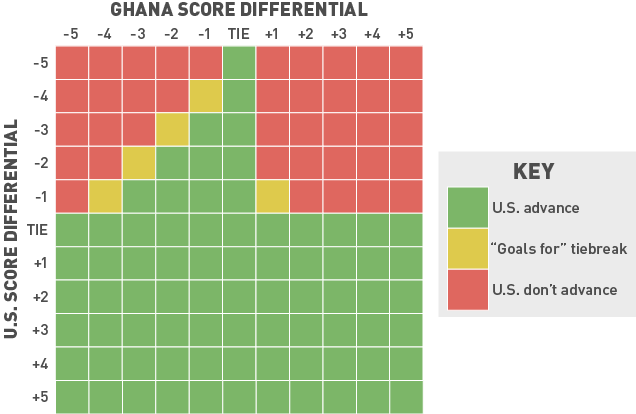
I was inspired by a post I read over at Deadspin during the World Cup where they outlined how all of the potential scenarios of the US vs. Portugal and Germany vs. Ghana games would impact the US's advancement into the next round of the tournament. I really liked the way the chart was presented, which grouped each of the 121 discrete outcomes into just three color-coded scenarios.


For some reason, that chart popped into my head when I was recently searching for award availability, and mulling over the value I would be getting on each possible redemption. Similar to the chart above, my thought-process was a series of decisions based on discrete scenarios, but instead of looking at goal differential I was comparing CPM of various Economy, Business, and First Class redemptions relative to my desired or target thresholds.

I imagine that's a similar question many of you ask yourselves each time you want to use airline miles  - "Is the CPM for this particular booking a good use of my miles?" The key here is that we can all agree that "good" is subjective, with some people valuing tickets using the actual sticker price, and others like myself, using something much lower.

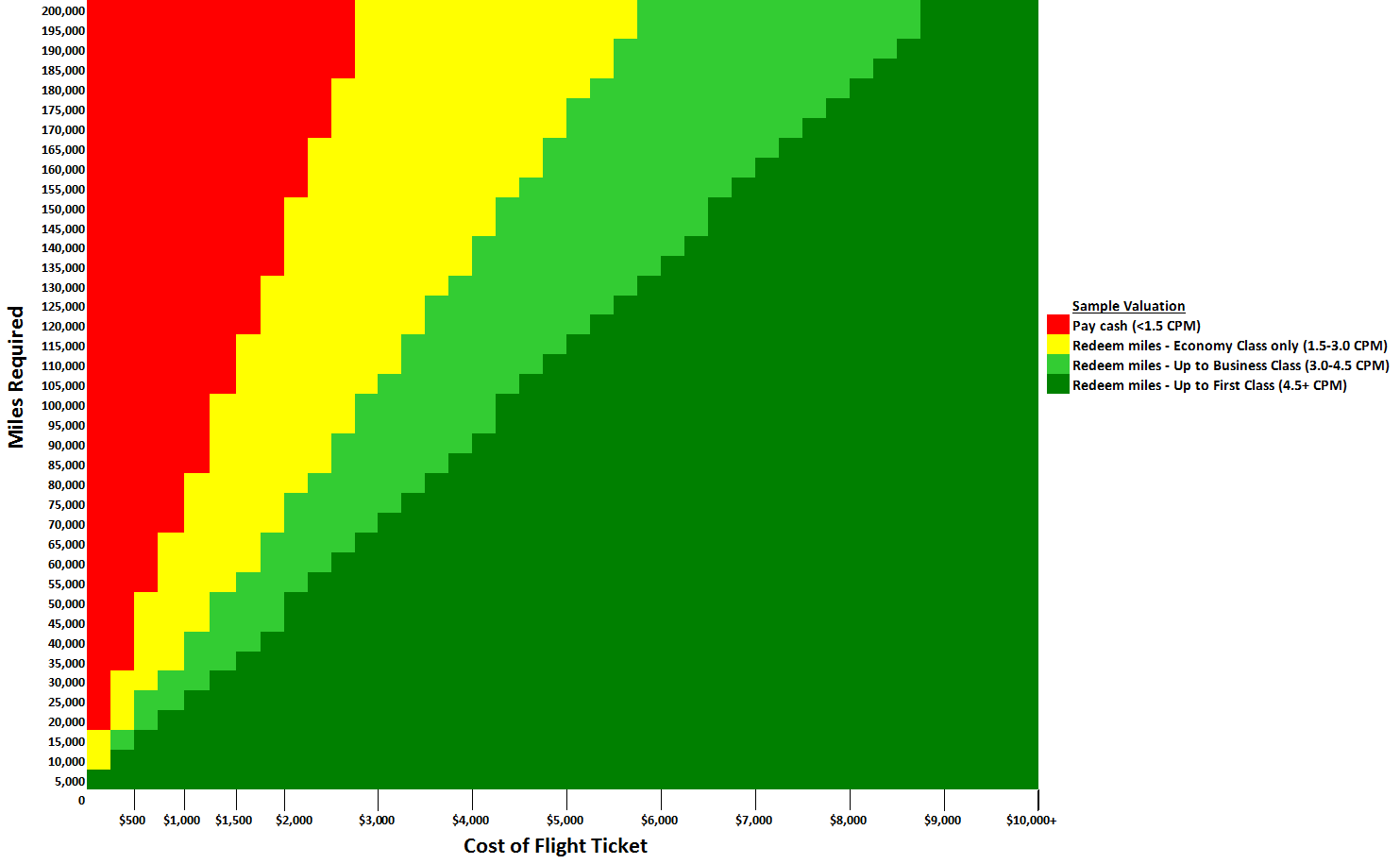
Based on an illustrative person's valuation of miles, the chart below shows a sample cheat sheet of when that person should use miles vs. cash for flights. It also shows the situations when using miles, when that person should book Economy, Business, or First Class tickets. Each cell in the chart represents a discrete situation based on number of miles required for a flight (Y-axis) and the cost of the flight ticket (X-axis). Baked into the CPM thresholds outlined in the key on the right, is the value that this person has placed on their miles at each booking class, which again will differ from person-to-person, and even by airline program.

For example let's say that this person is presented with the opportunity to redeem 140,000 miles on a flight redemption. At what point should they use miles, and if using miles, which class of ticket should they book? Based on this person's CPM targets, they would pay cash (shown in red) for any ticket up to a value of 1.5 CPM (~$2,100). Anything above that, then they would be willing to use miles. A similar decision-making process when choosing the class of booking. Based on this person's valuation of Business and First Class tickets relative to Economy class, they would be willing to book Business Class (in light green) within a range of 3.0-4.5 CPM in value ($4,200-$6,300), and First Class at a CPM greater value than 4.5 CPM ($6,300+).

It's important to note that the chart isn't saying anything about the typical number of miles needed to make a booking at each class (I know that it would be rare to need 140,000 miles to book an Economy ticket). Instead, it's simply showing the break-points at which this person would find enough CPM value to make a particular booking. For example, if someone was offered Business Class tickets for 140,000 miles and valued at $4,000, they they would happily make that booking since the value exceeds their target thresholds. However, the value would be too low to be considered an acceptable First Class booking.

As I mentioned, the key assumption here is baked into the CPM thresholds, which is each individual's valuation of their miles. Personally, I value Business Class tickets at only 2X the value of Economy tickets, even though they can easily cost 3-4x as much. Similarly, I value First Class tickets around 3X the cost of Economy, while actual costs can easily be 6-10X as much. Therefore, I have a lower value on premium cabin tickets than the sample person above, and therefore would require higher CPM redemption values before willing to make the same booking, as illustrated in the chart below:

As you can see here, while the sample person would be willing to book First Class tickets for 140,000 valued at $6,300, I wouldn't be willing to make that booking unless the flight ticket cost exceeded $9,800.

A couple of notes on methodology - I chunked the mileage redemptions into 5,000 mile increments, and the cost of flight tickets into $250 increments. While there is a clear line drawn between the colors, in reality there is a grey area between neighboring cells that cross into different colors. This would be especially prevalent in low mileage / low cost redemptions that you would find with domestic tickets.

So did I solve the million-dollar question "what is the value of airline miles?" Nope. But the value of this exercise for me was to, through some trial and error, determine what my "acceptable" thresholds really are that I am looking to get out each type of booking. Until now, it's a calculation that I had been doing anyways each time I looked at a potential redemption, but this was a good way to visualize the entire spectrum and to really see where those break points are.

I'm curious, what is your process for determining when an airline mileage redemption is a "good" value?

Wednesday, July 16, 2014

New US Routes On Etihad, Korean Air, And Virgin Atlantic And How To Use Your Miles to Book Them

Over the past week there have been some exciting announcements from Etihad, Korean Air, and Virgin Atlantic on new and improved route changes to the US. Here's a summary of the changes, and a reminder on how to use miles to book them:

Etihad

Etihad recently announced plans for daily flights from Abu Dhabi to San Francisco starting November 18th, which will be operated by a three-class Boeing 777-300ER leased from Jet Airways.  Each flight will have capacity for 8 seats in First Class, 30 seats in Business Class, and 308 seats in Economy.

San Francisco is the 5th US destination serviced by Etihad, which already flies daily to Los Angeles, Chicago, Washington DC, and twice-daily to New York. Dallas will be joining the list as the 6th destination starting December 3rd. As InsideFlyer outlines, there is a promotion offering double Etihad Guest miles across many of the new worldwide routes.

How to use your miles to book: The best option is to use your American Airlines miles which unfortunately can't be done online and will require calling in to book. One-way tickets from North America to Abu Dhabi cost 45,000 miles in Economy, 67,500 in Business Class, and 90,000 for First Class. While you can't search for award space on the AA website, the best options are either through Expertflyer or directly through the Etihad website.

I have yet to fly Etihad, but have been in the early stages of planning a trip to Africa and along with Emirates which also flies from San Francisco, using either of these carriers yields the most efficient routing with just one connection in the Middle East en route to Africa. Anecdotally, I have been seeing pretty good First Class award space both close-in and several months out, and imagine that it will only improve with the additional routes to San Francisco and Dallas.

Korean Air

Korean Air announced an increase in the frequency of flights to Hawaii from July 24th to September 10th, where the current 17x a week frequency will be increased to 21x a week to handle additional demand. Also worth noting that Korean Air will be increasing flight frequencies to Guam (although with recent LifeMiles changes, I suspect that traffic to Guam among us won't be as high) and Southeast Asia.

How to use your miles to book: Korean Air is a SkyTeam member, so Economy and Business Class tickets can be booked both with Korean Air Skymiles as well as through other SkyTeam partners. However, First Class bookings are only available using Korean Air Skymiles.

Korean Air Skymiles is a transfer partner of Chase Ultimate Rewards, which was the source for the miles used on my recent booking. Using Korean Air Skymiles, the one-way cost from Korea to North American locations is 35,000 in Economy, 62,500 in Business Class, and 80,000 in First Class during off-peak times. It's worth noting that there are peak times which cost 50% more.

We recently flew Korean Air First Class from San Francisco to the Maldives, and were able to take advantage of the free stopover in Seoul to stay for a few days. As I outlined here, the booking process isn't as seamless as with other airlines, but I estimate the sum total of time spent making the reservation (which included calling in since I wanted a stopover), filling out the redemption forms which included creation of a family account for myself/spouse, and lastly paying for the ticket via the phone system at approximately 30 minutes. Certainly time well spent to get access to the amazing premium cabin availability offered by Korean Air.

Virgin Atlantic

Virgin Atlantic announced two new routes from the UK: Belfast to Orlando and Glasgow to Las Vegas which will both be operated by a Boeing 747-400 and codeshared with Delta. Virgin is the only airline out there that offers these routes which will depart weekly on Thursdays, and each flight will hold 14 Upper Class, 66 Premium Economy, and 375 Economy seats.

The Belfast to Orlando route will begin operation on June 25th, 2015 during the months of June and July, and the Glasgow to Las Vegas route will being September 10th, 2015 for operation during the months of September and October. While both the limited number of months the routes will be offered and the 1x weekly frequency aren't earth-shattering, they do coincide with peak/holiday travel season and the added capacity and additional routes are certainly still an enhancement.

How to use miles to book: While I haven't had experience flying Virgin Atlantic, trying out the Upper Class product is high up there on my flying bucket list. Tickets from the UK to the US start at 35,000 in Economy and 80,000 in Upper Class, but come with hefty fuel surcharges that are tacked on. Virgin Atlantic is also partners with Hawaiian Air and a transfer partner of American Express Membership Rewards, which often offers promotions beyond the standard 1:1 ratio.

Anyone planning to take advantage of these new routes?

Sunday, February 2, 2014

Current Points/Miles Balances and My 2014 Strategy

After spending three years (2010-2012) mostly in accumulation mode, at the beginning of 2013 I was feeling ROKI-level rich with my points/miles balances sitting at over 2 million.

Before getting into this hobby/game, usually the biggest hurdle to taking a trip was finding the budget to travel (with finding time off work a close second). While the work hurdle still remains, it's amazing how having points/miles can change your mindset. By completely taking the budget hurdle out of the equation, it literally puts the world at your fingertips. We could go anywhere in the world at a moments notice, and even if we went to Asia or Europe just for a couple days, we wouldn't feel like we didn't "get our moneys worth" since the trip was financed using points/miles.

But as I sit here in early 2014 staring at my Awardwallet account on a cold Saturday night, things aren't looking as rosy. The reason is that 2013 was a total spending spree, the kind that would even make the Wolf of Wall Street proud. In total, I spent about 1.8 million on the following:

- 140,000 miles for my Bachelor Party trip to Bali
- 765,000 points/miles for our Honeymoon trip to Australia, Maldives, Sri Lanka, and Dubai
- 505,000 points/miles for our New Years trip to Hong Kong and Macau
- 390,000 miles for Business Class tickets to Hong Kong and Vietnam for my parents and Lisa's mom

Exacerbating the problem was the fact that we were in the market for a new home in 2013, and would need to secure a mortgage. As hard as it was, I was able to resist the urge to get new credit cards for the entire year to ensure that our credit scores were in tip-top shape. But I was able to earn back some miles through business and leisure trips, as well as putting almost all of our wedding spend on credit cards to accrue points.

Since my balances aren't as flush as before it isn't as easy to plan travel anywhere we want go to, which means that I've been keeping a close eye out for deals. And since we were able to grab a great deal on Cathay Pacific from the Maldives (even though this one is even better), we decided to plan another trip later this year to go back to the Maldives since our first trip just wasn't enough.

To get there, we'll be using Korean Air miles transferred from Chase Ultimate Rewards to fly First Class SFO-ICN-MLE. Since Korean Air permits a free stopover even on one-way tickets, we'll be using that to stay 2 nights in Seoul on the way over.

For hotels, there's a hotel in the Maldives that I've been dying to stay at that isn't affiliated with a chain, so we will be sucking it up and paying for it. But in Seoul, we'll be staying at the Park Hyatt for 15,000 Hyatt points on one night, and the other night paid for using the free anniversery night that comes with the Chase Hyatt credit card.

That's the only trip we have planned thus far, and since work is picking up for both us, we haven't been able to plan much beyond that. But in some ways that works out just fine, since it allows me to go back into accumulation-mode.

Here is a snapshot of my current balances, and a summary of what I'm planning to do in 2014 to build them back to pre-2013 levels:

American Airlines:

Current balance: 30,000

Even with the upcoming merger with US Airways, I really like American Airlines miles as they give access to One World airlines, as well as Etihad to the Middle East. And since our next top destination is the Seychelles, this is a perfect redemption for us to get there flying Etihad through Abu Dhabi. But that means we'll need to get up to 200,000 miles to fly there one-way in First Class.

2014 strategy:

- 50,000 miles for creating a new account with Fidelity
- 100,000 miles from 2 x 50,000 sign-up bonuses for the American Airlines Citibank credit card

United Airlines:

Current balance: 32,000

With the big devaluation here and the terrible award chart now in effect, I'm completely out on United. I'll use these miles for domestic flights where they make sense, but other than that I have no plans to accrue any more miles into this program.

2014 strategy:
- NOTHING

Korean Air Skypass:

Current balance: 270,000

This is one of the best programs out there for premium cabin (business and first class) availability. They are a member of SkyTeam so you can accrue points into this program by flying Delta for example, and they also have partnerships with Emirates and Etihad. The easiest way to get points in this program is to transfer from Chase Ultimate Rewards.

2014 strategy:

- 100,000 points from 2 x 50,000 Chase Ink Bold sign-up bonuses that can be transferred to Korean Air

Alaska Airlines:

Current balance: 0

As I mentioned before, since I'm officially done with United, this is now my primary airline that I'll be flying. I was able to get a status match from United 1K to Alaska Airlines MVP Gold, which will provide me with complimentary upgrades and mileage-earning bonuses [if you currently have status with an airline that will be expiring, always try to match to another airline before it expires. The United 1K status I earned by flying 100,000+ miles in a year was done 4 years ago, and I've been able to status match back-and-forth to different airlines since then].

Alaska is also perfect for our next big trip to the Seychelles, since it can get us access to Emirates or Etihad. But it will require 200,000 miles one-way to get there in first class, so I'll need to build up that balance quicky.

2014 strategy:

- 50,000 miles earned through annual work/leisure travel using Alaska as my primary airline
- 40,000 miles earned from Bank of America credit card sign-up bonus
- 50,000 miles earned from using this as primary credit card for spend, including manufactured spend and Amazon Payments

Singapore Airlines

Current balance: 21,000

Our next aspirational destination is Seychelles, but my next aspirational flight is Singapore Suites Class aboard their A380. This is the only commercial flight where you and a travel companion can snuggle up together in a double bed. Singapore only flies their A380 on certain longhaul routes, and there are only 4 specific ones (2 from Singapore to Europe, and 2 from Singapore to Australia) where they release 2 seats at a time. To book these seats, we'll need close to 200,000 miles so clearly we have a long way to go.

2014 strategy:

- 50,000 sign-up bonus for the Mercedes Benz American Express Platinum card [the $450 fee seems like a lot, but if you keep this card for 1 year you can get $400 in airline gift certificates for booking flights and $100 Global Entry reiumbursement which alone make up for the annual fee]
- 50,000 points transferred from my Starwood account
- 50,000 sign-up bonus for the American Express Gold card [planning to apply for this, have not yet as I'm waiting for a targetted offer since 25,000 is the best publicly available offer]

Avianca Lifemiles

Current balance: 52,000

The new kid on the block, and the absolute favorite among travel hackers. They regularly run promotions where you can purchase up to 150,000 miles per year, at a rate of 1.5 cents per mile. Why is that a good deal? Because their program has quite a few loopholes which allow travel to Asia or Europe for under $400 in business class. I won't go into more details for fear of those that want to keep this under wraps, but am happy to discuss privately if anyone is interested in hearing more.

2014 strategy:

- 150,000 miles purchased for $2,250, which can yield up to 6 trips in business class to either Europe or Asia

Summary

So in total, I'm hoping to grow my meager balance of ~400,000 miles to approx. 1.1 million by the end of the year.  The vast majority of it will be done with credit card sign-up bonuses now that I'm back in the game after taking 2013 off. Some will come from everyday spend on the cards, combined with manufactured spend. And some will come through purchasing miles, where I feel like I'll be getting an ROI that far exceeds the cost.

Wish me luck!


Current Balance 2014 Target Earned Ending Balance
American Airlines 30,000 150,000 180,000
United Airlines 32,000 0 32,000
Korean Air 270,000 100,000 370,000
Alaska Airlines 0 140,000 140,000
Singapore Airlines 21,000 150,000 171,000
Avianca Lifemiles 52,000 150,000 202,000
Total 405,000 690,000 1,095,000


Wednesday, January 22, 2014

"3 Extravagant Flights You'll Never Be Able To Afford" and How We Flew Them All


The fool.com should stick to investing advice - over the weekend they published an article about 3 Extravagant Flights You'll Never Be Able to Afford. This article makes me laugh for a couple of reasons. First, I'm not sure what the point of the article is, perhaps other than anti-1% propaganda? Secondly, it talks about extravagant First Class flights that cost $13,000-$22,000 without mentioning the fact that you can fly them all for far less than that. It would be like writing an article about how the average person could never dream of owning a $200,000 Ferrari, while there existed sort of well-known and some lesser-known ways to own one for as little as $50.

So I guess while the premise of the article is indeed true, that your average person would never be able to afford to pay those prices for First Class tickets, it certainly does not translate to mean that the average person cannot experience these flights - in fact, we've flown all 3. 2 of them were redeemed using miles, and 1 was a paid ticket but at a 90% discount off of the $22,000 he quoted. Let me explain how we did it.

Extravagant Airline #1 - Cathay Pacific

How we did it (price for each ticket) and how we got the miles 
We have actually flown Cathay Pacific twice:

SFO-HKG: 67,500 American Airlines miles + $5 in taxes/fees
HKG-SFO: 105,000 British Airways Avios + $142 in taxes/fees

- 150,000 American Airlines miles from 2 Citi American Airlines credit cards which offered 75,000 miles as a sign-up bonus each
- 50,000 American Airlines miles from opening a Fidelity brokerage account
- 150,000 British Airways Avios from a 100,000 Chase British Airways sign-up bonus + 50,000 from spend
- 60,000 British Airways Avios transferred from Chase Ultimate Rewards which came from a Chase Ink 50,000 sign-up bonus and subsequent spend

Alternative ways to do it and how to get the miles

SFO-HKG: 105,000 Cathay Pacific Asia Miles (transfer partner of American Express Membership Rewards)

- 100,000 sign-up bonus for American Express Platinum card
- 50,000 sign-up bonus for American Express Premier Rewards Gold card

This is actually the easiest of the 3 airlines he mentioned to fly with in First Class, as Cathay opens up much of it's First Class cabin for award tickets starting approximately 11 months in advance, and then usually opens up all remaining seats starting about 2 weeks prior to departure. Each airline handles this differently in terms of protecting it's First Class cabin from award bookings, but Cathay is among the most generous in that regard and make this an easy mileage redemption.

Extravagant Airline #2 - Singapore Airlines
How we did it (price for each ticket) and how we got the miles 

SFO-HKG: 70,000 United Airlines miles + $5 in taxes/fees

- 300,000 miles from flying United as my primary airline from 2011-2012
- 50,000 United Airlines miles from Chase United Explorer card sign-up bonus
- 80,000 transferred from Chase Ultimate Rewards from 2 Chase Sapphire Preferred card bonuses of 40,000 each

Alternative ways to do it and how to get the miles

SFO-HKG: 70,125 Singapore Airlines Krisflyer miles (transfer partner of American Express Membership Rewards)

- 100,000 sign-up bonus for American Express Platinum card
- 50,000 sign-up bonus for American Express Premier Rewards Gold card

Many people consider Singapore Airlines the gold standard for all airlines and the best in the world. They are also among the stingiest in terms of allowing access to their First Class cabins, which can only be redeemed through their own frequent flyer program and is blocked from all partners.

I'm still in the process of accumulating Singapore Krisflyer miles for a future redemption, so how did we get access to the highly-protected Singapore First Class cabin? In the summer of 2012, they were converting their reservation systems and for a short period of time (about a couple days), accidentally made all First Class award space available to their Star Alliance partners. This caused an absolute frenzy among those who were in the know, and I was fortunate enough to be able to use my United miles for the Singapore First Class redemption.

Even after flying some of the other heavy hitters (Emirates, Cathay, ANA, Thai), Singapore remains our favorite and I can't wait until I've saved up enough miles to fly them again.

Extravagant Airline #3 - Emirates

How we did it (price for each ticket) and how we got the miles 

CMB-DXB-LHR-SFO: $2,140.20 for First Class; MLE-DXB-LHR on Emirates and LHR-SFO on British Airways

This is the fun one - a lot of things going on here. First of all, while it's certainly more than I would like to have paid for a 1-way ticket the value I'm getting is undeniable as it's a great fare that is a 90% discount off the price of the standard First Class ticket on Emirates that he quoted (~$22,000).

So how did I get it? I don't know how to describe it other than the "random airport in a previously dangerous location" phenomenon. For some reason, airlines screw up the logic in their pricing systems for these types of places, most notably Sri Lanka (CMB) and Yangon, Myanmar (RGN) in recent years.

In fact, if you say the letters RGN to a hardcore travel hacker, odds are that their face will light up.
This was a truly amazing deal that I got the year before, where we flew home on Korean Air First Class from Yangon, Myanmar for $250 each! In fact, the miles we accrued from those flights exceeded the cost of the tickets themselves, meaning that we essentially got paid to fly. Lisa particularly loves these crazy fares, since I would never be adventurous enough to go to Myanmar or Sri Lanka if it weren't for these amazing fares.

The second interesting thing going on here is tangentially related to the concept of hidden-city ticketing. For example, the price of the ticket with the routing CMB-DXB-LHR-SFO was $2,140, but the price for that same ticket with the routing DXB-LHR-SFO was over $8,000. You might ask yourself, why the heck would I pay quadruple the price for a shorter route that has one less flight?

This is related to the concept of hidden-city ticketing, where it can be advantageous to add on additional legs to flights in order to save money. It's a big no-no from the airline Terms and Condition's standpoint, but it's rarely (if ever) enforced. A perfect example of this, was during the couple years I was flying to Chicago regularly to visit Lisa - often times the direct route to Chicago (SFO-ORD) would actually be more expensive than the route to Milwaukee that stopped in Chicago (SFO-ORD-MKE).

The reason this is hard to enforce, is after landing at ORD and during my layover, any of the following could happen a) getting sick at at the airport and not being able to make my connection b) having a work emergency at needing to go into the Chicago office c) deciding to change plans and meet up with friends for dinner in Chicago.  Any of these are feasible, and as long as you don't make a habit out of doing it it's very easy to get away with.

So again, why am I paying less for an additional flight!? Airline pricing systems are complex and I won't pretend to be an expert, but my understanding is that it has a lot to do with supply/demand and competition among certain routes. But it works for me, as I was happy to pay significantly less to fly a routing which actually included an additional flight.

Alternative ways to do it and how to get the miles

CMB-DXB-SFO: 168,750 Emirates Skywards miles (transfer partner of American Express Membership Rewards)

- 100,000 sign-up bonus for American Express Platinum card
- 50,000 sign-up bonus for American Express Premier Rewards Gold card

CMB-DXB-SFO: 100,000 Alaska Airlines Mileage Plan miles

- 50,000 sign-up bonus for Bank of America Alaska Airlines card
- Purchase up to 10,000 Alaska Airlines miles for $0.02 each every time you purchase an Alaska Airlines ticket

As you can see above, Alaska Airlines' program provides a much better value than booking directly through Emirates' program, and would even offer a stopover in Dubai along the way.

Friday, January 17, 2014

How to Become a (Points/Miles) Millionaire

Earlier this week, I wrote a post about the New York Times' 2014 Places to Go which also included a high-level and brief overview of utilizing credit card sign-up bonuses to amass hundreds of thousands of points quickly.

Since I'm relatively new to all this as well having only seriously gotten into the points/miles game in 2011, I thought that it'd be helpful to create a how-to guide of things that helped me when first getting started along with other pointers that I've picked up along the way.

1. Take a step back and figure out what kind of traveler you are

Before just diving head-first into everything, it's worth taking a step back and thinking about what sort of traveler you are. And not just in terms of how you've been traveling, but also in the context of how you want to be traveling.

For some people, they would prefer taking 2 trips in economy vs. 1 in business or first class, and similarly would prefer staying 2-3 nights at an average hotel vs. 1 night in a luxury hotel. Or some people may only care about amassing frequent flier miles for free flights, since they prefer to stay at hostels or take cruises which generally do not belong to any loyalty programs.

So do you want points/miles primarily to get free flights and hotels to travel more frequently?
Or do you want them to get aspirational travel in first class cabins and luxury hotels that you otherwise would never pay for?
Do you care more about the quantity of trips you can take, or increasing the comfort for each trip?
What's on your bucket list, mostly domestic or international destinations?
Would you prefer taking 3 short 1-week trips or one mega 3-week trip?
How would you spend a week of vacation- 7 cities in 7 days or hunker down and stay in 1 city for 7 days?

These are all important questions to ask yourself, because it will help to pick the optimal programs into which you should collect points/miles. For me, the biggest constraint on my ability to travel was time - so the most important aspect of points/miles for me was to enhance the comfort of each trip, as opposed to taking more trips. So I would consider myself an aspirational traveler, where I use my points to get access to $15,000 first class airfare tickets and stay in $1,000 per night hotel rooms that I would never otherwise pay for.

The reason some of the other questions are important is that each frequent flier and hotel program has a sweet spot for redeeming points/miles, and it's not always the same. For example, if Europe or Australia is next on your bucket list then I'd recommend the Star Alliance (*A) whereas for Africa I'd recommend Alaska Airlines.  For mid-range vs. luxury hotels, the best program also varies, and different programs are even better for solo vs. traveling with multiple people together as for example both Korean Air and British Airways allow you to create household accounts that can pool points across multiple accounts.

So do take some time and treat this decision as you would with a large purchase - do some research beforehand and figure out which program is best for your specific travel goals and destinations. 

2. Where do you want to go next?

The points/miles game can be intimidating, and the hardest part is just getting started. But everyone who's thinking about getting into this game more than likely enjoys travel, and probably even has a bucket list of top places they've been dying to visit.  And by narrowing down your focus to a singular goal, which for me was "how can I plan a trip to the Maldives using points/miles?", it allows you to start accumulating toward that specific goal instead of just collecting points/miles randomly and hoping that you'll someday achieve that goal. For others, it may be getting a free trip to Mexico or Hawaii, or something even more practical such as for those away at school, getting free flights back home several times a year which can save a lot of money, especially since those flights generally come during holidays.

If you use a shotgun or spray-and-pray method to accumulating points, you'll end up with a lot of points spread over a lot of different programs, which essentially become useless. Having 10,000 points in 10 programs is absolutely not the same as having 100,000 points in 1 program. Figure out what program and how many points you need, and accumulate points only in those programs. You'll have plenty of time to diversify later on, but you need critical mass in your top programs first in order to be able to do anything.

3. Get Organized

If you invest in the stock market, you wouldn't have records of each stock you own in different places with nothing in place to track performance. Points and miles should be treated the same way.

I recommend signing up for AwardWallet which is a free tool that allows you to track all of your programs in one place.  For programs where you already have membership and points, input those in. You can even input programs for multiple people, which is helpful for really tracking everything in one place.  And for programs that you think you'll be needing, signup for membership accounts directly through that program's website, then link back to your AwardWallet account.

4. Using credit card sign-up bonuses to get points quickly

Before I touch on this in more detail, if you have any upcoming plans that require financing (mortgage, re-financing, new car purchase) in the next 12 months, stop right now. More important than free travel is being able to get the best interest rate on those purchases, and you need your credit score in tip-top shape to do so. As I mentioned before, credit card applications will hit your score in the short-term (6-12 months) by an average of 3-5 points each, so just hold off until you've finished before proceeding with the credit card game.

Here are some other quick hit tips on credit cards:
  • Before getting into this game, make sure you're ready to handle the financial responsibility of paying your balances on time across several cards and bank. When you have credit cards across all the major banks (Chase, Citi, Amex, Barclays, BofA) it can be a lot of work just making sure you are keeping track of when bills are due from each and getting them paid on time
  • There's a sweet spot in the number of credit cards you want to have - not too many, but also not too few. So what that means, is STOP applying for credit cards that don't earn you points/miles. That's cool that Banana Republic wants to give you 10% off the purchase of a sweater, but don't do it. It's not worth wasting a precious line of credit to save $10 when you could be getting $1,000 in free travel from that same line of credit
  • Almost every airline and hotel has its own branded card, and you can apply for these based on your programs of choice.  Here are a few examples from a blogger that I like to read, and in general I'd recommend Boarding Area as a great source of travel-related information
  • Additionally, a few programs offer that offer the ability to transfer points/miles are Chase Ultimate Rewards (recommend the Chase Sapphire card), American Express Membership Rewards (recommend the Premier Rewards Gold card), and Starwood Hotels loyalty program
  • Most of the good cards require an annual fee, but most also waive that annual fee for the first year. Even if they don't, generally the sign-up bonuses (depending on how you value them) can be worth $500 - $1,000 in free travel, so still provide great value even if paying a $65-$95 annual fee
  • Most cards require a "minimum spend" to get the sign-up bonus, which is an amount of spend in a specified period (e.g. $5,000 spend in 3 months). Especially if you're getting multiple cards at once, track all this carefully so you know exactly how much you need to spend on each to get the bonus. 

    But don't be afraid to sign-up for multiple cards at once because minimum spend requirements are easy to meet through creative ways which are often referred to as "manufactured spend".  For example, if I sign up for 5 cards at once, each with a $5,000 spend required in 3 months, that essentially means I need to spend $25,000 across these cards in the next 3 months.  Of course there's no way that I spend that much typically, but let's say that I'd normally spend about $5,000 during those 3 months.  I can easily manufacture $20,000 in spend across the cards, which boils down to spending money on a credit card, but essentially getting that money back in cash in order to pay off the credit card bill. More on this topic some other time
  • Do not, I repeat do not, cancel the card within 6 months of opening it.  Typically, I will keep the card for 10-11 months before cancelling.  If you cancel right away, more than likely your sign-up bonus will be retracted. Whether you got hit with an annual fee or not, there is no downside to keeping the card for 11 months before cancelling
  • After cancelling the card, don't apply for the same one in hopes of getting the bonus again. You likely won't, as most cards require at least 12-24 months before you can get another bonus. Move on to other cards in the mean time, as there as plenty out there to choose from
5. Accrue points in all other aspects of your daily life

There are so, so many ways that you're probably foregoing earning points in your daily life right now, here are just a few examples:
  • Unless you absolutely have to, avoid using cash and pay with your credit card, and under no circumstance should you be using a debit card for purchases
  • Make sure that you're earning points on all travel (flights, hotels, rental cars, etc.) by having your membership number entered, and again as a rule of thumb don't accue flight points in multiple programs within the same alliance
  • Use the appropriate credit card in each situation - for example the Chase Sapphire card earns 2x points on all dining and travel such as airfare/hotels, and travel is even loosely defined to  include taxis/Uber, parking garage fees, etc. The Amex PRG offers 2x points on gas and groceries, and Chase Ink card earns 5x points on utilities such as cell phone and cable/internet as well as office supply stores like Office Depot and Staples
  • Sign-up all your credit cards for a dining program such as United's Mileage Plus Dining or American Airlines' AAdvantage Dining. You can link these to your frequent flier program/credit cards and automatically get points for eating at restaurants. I typically don't seek out these restaurants, but since all my credit cards are linked then it's more that I'll get an unexpected surprise of some bonus points each time I visit a participating restaurant or bar
  • The majority of my shopping is now done online, and everytime you shop online it should be done through a shopping portal.  Here's a nice summary of how that works, but essentially you are getting bonus points (often 5+ bonus points per $ spend) on items that you were planning to buy anyways and for the same price, just by first entering the site through a shopping portal
  • Keep an eye out for other miscellaneous ways to earn points, such as:
    • Up to 50,000 bonus points annually by using Fidelity
    • Using BankDirect for your checking account or CD 
    • Getting miles for Netflix subscriptions
    • Retention bonuses for credit cards where you call in each year and threaten to cancel, even if you don't really want to cancel
    • And even getting points/miles for delays, cancellations, and even complaints. In fact, we just got 100,000 British Airways miles because our recent BA flight had an older version of the first class seats than what is available on other BA planes, and I wrote in to complain after hearing that others had done the same
6. Earning points is the easy part, now how to spend them

Finally, I tell people this all the time, but earning points is really the easy part. The hard part which requires even more skill and knowledge is how to best use them.  As an example, I've been able to take the same number of miles someone was planning to spend on trip, and at no additional cost get 2 additional free flights added to the itinerary, one of which was even on a future trip that they were already planning to take.  Each program has different ticketing rules, and it takes a lot of time and research to learn how to maximize your miles within the confines of those rules.  That's another topic for another day, but I'm more than happy to give people pointers in the mean time.

Monday, January 13, 2014

New York Times 52 Places to Go in 2014: Where I Want to Go and How I'd Get There

The New York Times just released it's annual list of places to go in 2014 - this year's list features 52 exciting and amazing destinations. If traveling was my full time job I would love to go to all 52, but one can only dream. So each year we typically narrow down the list to a couple destinations that we would really like to visit, and start to figure out strategies for getting there. From the 2013 list, we were able to hit #31 Sri Lanka, #33 Bangkok, #42 Myanmar (technically went in December 2012), and #44 Washington DC.

As I was perusing this year's list I got the idea for this post - since I've been getting questions from a lot of people (friends, family, coworkers, and even strangers) asking how the heck we get to fly for free, often times in first class. So as we are doing some preliminary planning for 2014 travel, I figured that I'd share my strategy and thought-process for booking flights to a couple of the destinations among our top 5 from the list. Who knows if we'll even get to go to any of these, but it's fun to think about since we have the points/miles to fly there anytime this year, even this weekend, and all for free  :)  Here's our top 5 travel wish list for 2014:

#7 Ecuador
#23 Dubai
#27 Seychelles
#38 Arctic Circle
#39. Dar Es Salaam

#7. Ecuador

This is definitely #1 on our bucket list, and specifically we've been dying to go to the Galapagos to spend a week diving with turtles and hanging out with the amazing wildlife down there. Hotels are actually a tough one here since there aren't many chains to start with, but the best way to see the Galapagos is actually via cruise.

So assuming that we would book a cruise, the main questions is "how am I going to fly there?" This is where it's important to have a basic understanding of the airlines and their route networks within each of the major alliances:

- Star Alliance (*A)
- One World (OW)
- SkyTeam (ST)

The links to each of them show the member airlines within each alliance, and a bit of research beyond that will show where each individual airline's hubs are located and more importantly where their route network can take you.

So which airlines look good for getting to Quito, Ecuador (UIO)? From here I hopped over to kayak.com which will show almost all of the flight options available, and I found the following options (many more were displayed but I filtered down to options with only 1 connection):

1. United Airlines (*A): SFO-IAH-UIO
2. American Airlines (OW): SFO-MIA-UIO
3. Aeromexico (ST): SFO-MEX-UIO
4. Delta (ST): SFO-ATL-UIO

I'm actually surprised by the number of options here, and most importantly that they span across all three alliances. Often times, specific destinations are only serviced by a single alliance, and if you have all your eggs in another alliance's basket, they're essentially useless.

In this specific case, I have enough United miles already for a round-trip (40,000 economy / 70,000 business class) or American Airlines miles (35,000 economy / 60,000 business class) to book the ticket, and could utilize either based on my preferred dates and routing being available.

But let's say that I didn't have any miles, as is the situation that many are in as they are just getting into this game. How would I get enough miles for 2 economy tickets on United (80,000 total) or American (70,000 economy) to get there? There's a few ways, but they all require some time (several months) which is why it's important that all of this goes into the planning process well in advance, and not the month before you want to go.

The easiest way to get miles is through flying - if you travel regularly always make sure your frequent flier # is entered, and don't use multiple numbers within the same alliance. For example, if you're taking a flight on Lufthansa or Singapore Airlines (both members of the *A), in general it's best to credit to United if that's your primary account. After each flight you'll receive the miles a few days later, and if you're a heavy flyer (100,000+ miles per year) you'll likely earn more than 200,000+ miles with all of the bonuses that come with elite status.

If you don't fly regularly, like me, the next best way to get miles quickly is through credit card sign-up bonuses. Based on the card you get, it's really easy to get 50,000 to even 100,000 miles/points for each card you sign-up for.  Most credit cards are specific to the airlines (e.g. United, American, Delta, etc.) but a few programs that allow transfers into multiple frequent flier programs are:

- Chase Ultimate Rewards (recommend the Chase Sapphire card),
- American Express Membership Rewards (recommend the Premier Rewards Gold card),
- Starwood Hotels loyalty program

So there you have it, with the right credit card strategy and 2-3 good sign-up bonuses, you'd have enough points to get to Ecuador, with even some leftover. And one of the biggest misconceptions about credit cards are that they kill your credit score, which is just not true. While each credit card application does hit your score by 3-5 points in the short-term (3-6 months), in the long-term it's actually more important to show your credit worthiness by having multiple lines of credit which will also help your utilization %, of course assuming that you manage everything responsibly and pay your bills on-time.

#23 Dubai / #27 Seychelles

The next destination I'll cover is actually the combination of Dubai and Seychelles and I'll explain why I can kill two birds with one stone later.  Every since our honeymoon when we got to spend an extended layover in Dubai, I've been wanting to go back to enjoy more of the opulence and extravagance of the city. And now that we checked the Maldives off of our bucket list (although I'm dying to go back), we've heard that the Seychelles in Africa is equally amazing, and was even good enough for Prince William and the Duchess of Cambridge's honeymoon.

Starting with the same method as the prior section, jumping over to kayak.com doesn't yield many options. And man, the Seychelles is a long, long way from SFO with almost all routes logging in at well over 24 hours. This woudln't even include the seaplane or speedboat transfer that we'd have to take after arriving at the main airport.  Here are some of the limited options that I found:

1. Emirates: SFO-DXB-SEZ
2. Etihad (OW): SFO-DUB-AUH-SEZ

While Etihad bookings are available through OW points, for me there would be no need to look past #1 on the list.  We recently flew Emirates on the way home from our honeymoon and it was as blinged-out as advertised, even featuring a freaking shower on-board the plane.  Unfortunately, Emirates isn't part of any alliance, so there are a couple ways to book this. The first would be directly through Emirates' frequent flyer program, which is a transfer partner of Amex Membership Rewards and is definitely an option for booking flights. Most of my friends' companies use Amex for their Corporate Cards, so if you're flush with Amex points from all your expenses, this would be a great option.

But my new airline of choice, Alaska Airlines, also has a partnership with Emirates which allows bookings using their program's miles.  Emirates has a few other individual partnerships with airlines such as Korean Air (ST), so it's important to spread your knowledge beyond just the three major alliances as well.

And, the reason I'd use Alaska miles for this trip is that they permit a stopover on the booking, meaning that if SFO and SEZ are my origin and destination, I can stop at an intermediary destination along the way for the same price.  Without the ability to utilize a stopover, I would either have to fly to SEZ and skip Dubai, or book two separate tickets which would cost more.

So how many miles would it take to get there? If I'm flying that far I'd like to go in business class at least (155,000 miles per person), and would probably even splurge for first class (200,000 miles per person).  Unless I'm ditching Lisa at home, that means we are talking about 310,000 miles round-trip for business class or 400,000 miles for first class for the two of us. OUCH. That's a lot of miles, and my current balance is zero.  So how would I get the miles needed? A few ways:

- Start crediting all flights to Alaska (Alaska, Delta, and American) - I don't travel much for work but we'd accrue each about 50,000 per year from leisure travel = 100,000 miles
- Sign-up myself and Lisa for Alaska Airlines credit cards through Bank of America - current sign-up bonus of 50,000 x 2 = 100,000
- Sign-up myself and Lisa for Starwood Amex cards with the intent to transfer to Alaska - 30,000 x 2 = 60,000 Starwood points = 75,000 Alaska miles when transferred

The credit card game takes at least a few months to actually get the points, but right here we'd already have 275,000 Alaska miles between the two of us. Given that we were starting from zero, this would be a longer term redemption and would probably take another year of flying before getting the needed balance.

If we really wanted to go this year, another option would be book a one-way trip at 1/2 the round-trip cost (200,000 in first class for example) with the Alaska miles we earned here, and then use American miles to book Etihad back. Flying completely different alliances outbound/return is a strategy that I often utilize.
____________________________________________________________

So there we have it - a brief summary of the strategy I'll be using to get us to a couple of the places on the 2014 NYT list, and a very, very high overview of using points/miles to get there for free. Seriously, don't be afraid to sign-up for credit cards as they are the quickest and best way to earn points/miles in chunks. And for those skeptics that usually follow that statement with "yeah, but it will kill your credit score", mine is doing just fine at a few points below 800.  Using this strategy I was able to earn and burn over 1.5 million points/miles in 2013 alone which basically allowed us to travel the world on our honeymoon for free.  Happy earning, and for those that do pursue this hobby, I'm sorry in advance for getting you addicted :)